Why a Shared Shelf Gets Cluttered Again
Shared shelf clutter returns when ownership and return places are unclear. Name each zone and destination so everyday items have an obvious home.
The common mistake with shared shelf clutter is treating it as a tidying problem: clear everything, wipe the surface, and put the objects back. The shelf soon fills again because nobody knows whose things belong there or where they should go after use.
A shared shelf works less like a display and more like a small public counter. It needs two kinds of information: who is responsible for an item, and what place it returns to. Without both, even a neatly arranged shelf is only clutter on a temporary lease.
Why does a shared shelf get cluttered again?
Items collect when the shelf is the easiest place to put something down but offers no clear answer about what happens next. A parcel opener, a roll of tape, a library book, and a household member’s sunglasses may all land there for different reasons. The surface becomes a waiting room for decisions.
Unclear ownership adds another delay. Someone may leave an object alone because they are unsure whether it belongs to a housemate, is being used, or should be put away. Other people then add their own items, and the original uncertainty becomes part of the furniture.
A reset does not resolve either cause. It changes the shelf’s appearance without changing the choices people face when they arrive carrying something. The useful question is not merely what can be removed, but where each permitted item belongs and who can decide when it no longer belongs there.
How can you tell which items belong there?
Start by observing the shelf during ordinary use rather than sorting it by appearance. Notice what people reach for, what they leave temporarily, and what seems to have settled there without a clear purpose. A clean but unused item may still be a poor fit; a well-used object may deserve a reliable place.
Ask the people who use the space to identify items as shared, individually owned, or awaiting a decision. Keep that distinction simple. If ownership is uncertain, make a temporary holding area elsewhere and ask the household to claim items by an agreed time; do not quietly assign somebody else’s belongings to the donation pile.
Then decide what the shelf is for. A shelf near the entry might hold shared items needed on the way out, while one beside a dining table might be reserved for current household mail and supplies. A purpose that fits the location is easier to remember than a rule based on abstract neatness.
What does a useful shelf zone look like?
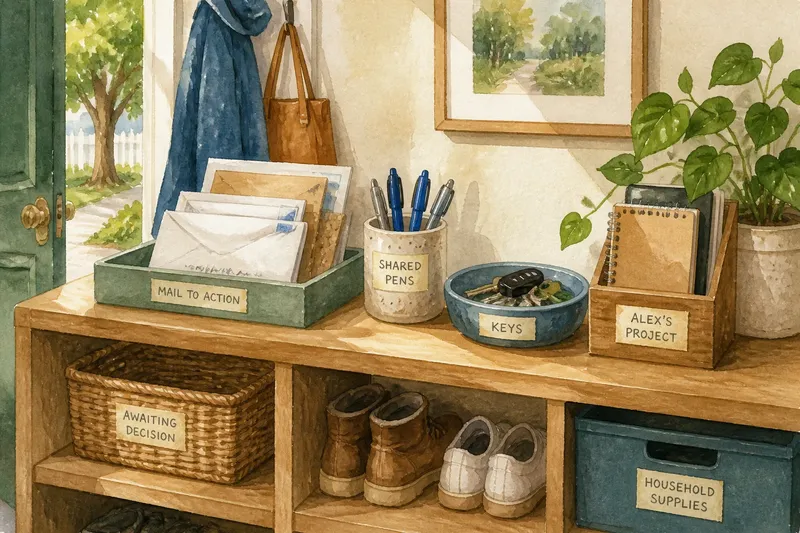
Give each kind of item a recognizable zone, not a vague instruction to “keep things tidy.” A tray could hold incoming mail that needs attention; a small cup could contain shared pens; a marked section could be reserved for one person’s current project. A zone should tell a person what belongs there at a glance.
Use objects already suited to the shelf, such as a shallow tray, a bookend, or removable label tape. Avoid dividing the surface into so many categories that returning a single item becomes a filing exercise. The point is to reduce decisions, not to create a tiny municipal records office.
Ownership can be visible without turning the shelf into a row of nameplates. A label such as “shared” or “Maya” can settle an otherwise recurring question. For a household with changing needs, use labels that are easy to revise rather than permanent marks that preserve an old arrangement out of politeness.
Where should each item go when it leaves the shelf?
A zone says where an item may sit; a destination says where it goes after use. Shared scissors might return to a labeled cup on the same shelf. A book someone is reading might have a designated “currently borrowed” slot, while an individual’s keys should return to that person’s usual landing place rather than remain among communal supplies.
Destinations work best when they are close to the activity and easy to identify. If scissors are used at the kitchen table, a return cup across the house is unlikely to help. Think of a destination as the hook for a coat: the object can be put away without a fresh decision about where “away” is.
Say two housemates use a shelf beside the front door for shared mail, spare keys, and a tape measure. They agree that the tray is only for mail awaiting action, put the keys in a labeled dish, and move the tape measure to the drawer where household tools are kept. The expected observable result is that each person can tell what remains unresolved and where the other objects should return, without asking who left them there.
How do you agree on rules without making the shelf a project?
Keep the agreement short enough to remember: name the shelf’s purpose, identify who owns personal items, and state the return place for shared ones. Ask the people who use it to help choose the zones. A rule imposed by the tidiest person may look clear on paper and still fail at the moment someone needs to put down a grocery receipt.
Set one simple boundary for overflow. For instance, if the incoming-mail tray is full, mail needs sorting rather than stacking beside it. For personal belongings, ask the owner to clear their zone when it no longer serves its stated purpose. The boundary should prompt a decision, not invite someone else to guess what can be discarded.
Labels and containers should fit the shelf and its materials. Check product instructions before applying adhesive to a finished surface, and consider local household needs when choosing what to store. This is a small job, but a finish can still object to a label more strongly than its owner does.
What questions help settle a shared shelf?
Should every person get a separate section?
Only if individual belongings genuinely need to stay on the shelf. A personal section can clarify ownership, but it should not become an unbounded storage allowance. For occasional items, a labeled tray or another agreed location may be simpler.
What should happen to unclaimed items?
Move them to a temporary, visible holding place and give the household a clear opportunity to identify them. After that, the owner or household can decide whether to store, return, donate, or discard each item. Avoid treating uncertainty as permission to dispose of someone else’s property.
How many zones should the shelf have?
Use only as many as the shelf’s regular purposes require. If people cannot tell quickly which zone fits an item, combine categories or give the item a destination elsewhere. A useful arrangement is easier to follow than a detailed one.
What if the shelf is still crowded?
Revisit its purpose and ask whether some items need a different home or whether the shelf is serving too many activities. Add capacity only when the items belong there and have clear destinations; another container can otherwise preserve the same ambiguity in a more attractive shape.
How can you keep the arrangement useful?
Check the shelf during a normal household pause, such as when sorting mail or returning shared supplies. Look for items with no owner, zones that have acquired unrelated objects, and destinations people cannot remember. Adjust the arrangement when use has changed rather than defending it because the labels are already in place.
The phrase “shared shelf clutter” often points to a missing agreement, not a failure of discipline. Once each zone has a purpose and each item has a return place, people can put things away without interpreting one another’s intentions. That is a modest improvement, but a household surface earns its keep by making ordinary decisions less mysterious.