How Households Kept Used Clothes Before Laundry Hampers
How households kept used clothes depended on space and washing routines. See the practical holding places people used and what each arrangement made easier.
The familiar mistake is to imagine that every household once had one standard way to handle worn clothes, replaced later by the laundry hamper. How households kept used clothes depended on where they changed, what storage they had, and how washing was organized; without a specific time and place, any single historical account would be too neat.
Where did worn clothes go before hampers were common?
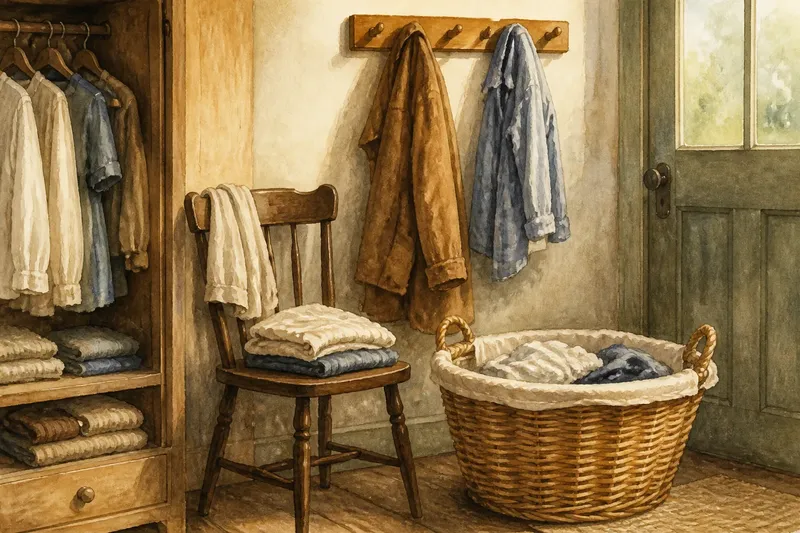
There was no universal predecessor to the hamper. In a household with a bedroom wardrobe, a garment fit to wear again might be hung apart from clean clothes or folded on a shelf. A coat could remain on a peg near the door, while garments ready for washing might be gathered in a basket, sack, or other available container.
Those are practical possibilities, not claims that every household used the same objects. The important distinction is that storage for wearing again and collection for washing are different jobs. A chair could serve as temporary storage; it was not, by itself, a laundry system.
Household arrangements also depended on the work involved in washing. Where laundry required preparation or took place away from the rooms where people dressed, collecting garments could make the work easier to organize. Where washing happened more directly, clothes might be carried to the wash area without a long wait in a dedicated container.
What changed when a household used a laundry container?
A container gave clothes awaiting washing a visible destination. That could help people gather garments before washing, carry them to the work area, or keep them apart from items intended for another wearing. The exact role depended on the container and the household’s routine; “hamper” and “basket” have never needed to describe one fixed arrangement.
Purpose-made containers made the collection point easier to recognize, but they did not settle every decision about clothes. A shirt worn briefly and a damp work garment might need different handling. A container could collect either one, but the household still had to decide what belonged together.
The change is best understood as a change in visible household practice, not a clean historical handoff from one universal custom to another. A hamper might replace a basket in one home, sit alongside a wardrobe in another, or have little use where people carried laundry directly to its washing place.
What arrangements did households use?
Three approaches cover the basic choices: gather laundry in one shared place, use local temporary storage, or keep different kinds of garments separate. Each suits a different path through the home, and each can become inconvenient if its purpose is unclear.
One shared collection point
A single basket or hamper gives household members one recognizable place for clothes awaiting washing. It suits a routine where garments can reach that point easily, but it may collect items that someone meant to air or wear again.
Local holding places
A peg by the door, a wardrobe section, or a chair used for airing can keep garments near the room where they are taken off. The tradeoff is that someone must later gather items intended for washing; otherwise, separate places become separate, easily forgotten collections.
Separate places for different purposes
A household can keep garments for another wearing apart from laundry, or set damp items aside instead of mixing them with dry clothes. This works only if people understand the distinction. A label or an agreed location can be clearer than expecting everyone to interpret a pile correctly.
How can a household decide which arrangement fits?
Follow the route clothes already take: note where people change, where they leave garments, and where laundry is handled. Then choose a place that supports that route rather than adding an extra trip.
- Check whether most people change near the same room. If they do, put one collection container on that route; if not, use local holding places and plan how items will be gathered.
- Check whether clothes are often left beside the container. If they are, move it closer to where garments come off; if the location is already convenient, clarify what belongs inside.
- Check whether people regularly save garments for another wearing. If they do, provide a separate peg or shelf; if not, a single collection point may be simpler.
- Check whether damp items enter the collection. If they do, set a distinct airing place; if they do not, keep the ordinary laundry route unchanged.
- Check whether laundry is collected from several rooms. If it is, assign a clear gathering routine; if it is not, keep the collection near the usual wash-area route.
- Check whether everyone understands the arrangement. If they do, keep the labels minimal; if they do not, add a plain label or simplify the categories.
Say a household has a bedroom wardrobe, a peg beside the back door, and a shared laundry basket in the hall. One person leaves a coat and damp work shirt by the door, while another puts everyday clothes straight in the basket. They agree that the coat stays on the peg, the damp shirt airs separately, and only clothes ready for washing go in the basket. The resulting arrangement keeps the basket for laundry and gives the other garments distinct destinations; the tradeoff is that someone must remember to move the aired shirt if it later needs washing.
A simple analogy helps: a laundry container is like a mail tray. It gives one kind of item a place, but it cannot decide what belongs there or where the item goes next.
What do people ask about how households kept used clothes?
Did households use laundry hampers before washing machines?
A collection container does not require a washing machine; it can hold clothes until washing takes place by whatever method a household uses. Its form and purpose vary, so the existence of a container does not establish one standard historical routine.
Did a laundry basket have the same job as a hamper?
The terms overlap in ordinary use. One household may use a basket to collect clothes and another to carry them, so the object’s actual job matters more than its name.
Where should clothes intended for another wearing go?
Keep them apart from clothes ready for washing, using a peg, wardrobe section, or shelf that makes the distinction easy to see. The best location is one people will use without adding an awkward detour.
Did every household collect laundry in one place?
No single arrangement applies to every household. Space, washing routines, and where people changed all affect whether one collection point or several local places make more sense.
How households kept used clothes is less a story of one object replacing another than of homes assigning places to different tasks. For a present-day arrangement, the useful question is whether a garment is ready for washing, set aside for another wearing, or being aired; give each category a clear place only if the household needs that distinction.